Tag Archives: OPEC

China y América Latina: ¿Quién gana y quién pierde? – Petroguía 2014 (Spanish)

Inversiones energéticos de  China en Latino américa.  Nota que Venezuela está en tercer lugar, en contra de las intenciones iniciales de Beijing en 2007-08.

Inversiones energéticos de China en Latino américa. Nota que Venezuela está en cuatro lugar, en contra de las intenciones iniciales de Beijíng en 2007-08. HAZ CLICK para magnificar. (Grafico por T.O’D.)

[English readers: This post is an analysis I did in Spanish for Petroguía 2014 – the annual hard-copy guide for the LatAm petroleum sector – of China’s oil and gas investments in LatAm and the Carribean.  For Beijing’s other investments, or a presentation, etc. drop me a line. ]

NOTA: La siguiente es mi análisis publicado en Petroguía 2014, la guía anual para el sector petrolífero latinoamericano.  Soy agradecido a los directores del Petroguía por haberme permitido publicar el artículo aquí.  El artículo es una resumen de una investigación que hizo sobre todas las inversiones de China en Latino américa. Si tienen interés en una reportaje o presentación detallada, por favor contactarme.

China y América Latina: ¿Quién gana y quién pierde?

Sumario. El mercado de hidrocarburos ya no está en el norte de América sino hacia el este,  y la mejor estrategia de intercambio con esa plaza la lleva Brasil, mientras que Venezuela y Argentina están a la zaga.

Por Thomas W. O’Donnell

El petróleo y el gas que exportará América Latina en las décadas venideras irán mayormente a China y otras partes de Asia. Y eso es por el efecto combinado de menores necesidades de energía importada en Estados Unidos, gracias a la utilización de los nuevos métodos de fractura hidráulica (fracking) que produce cada vez más petróleo liviano, y por el tope que ha alcanzado su demanda doméstica. Continue reading

My AS/COA piece: PDVSA Post-Chavez: Will Partnerships with the Private Sector and Chinese Experts Boost PDVSA Oil Production?

PDVSA oil rigs in Venezuela (TalCual)

PDVSA oil rigs in Venezuela (TalCual)

Throughout 2012, and especially after President Hugo Chávez’ death in early March 2013, Venezuela’s national oil firm, Petróleos de Venezuela S.A. (PDVSA), has taken measures beyond anything done in the past decade to raise its lagging production. While the likely impact merits cautious analysis, the drivers of the Bolivarian Republic’s scramble for increased oil revenues are clear.  … Continue reading

My talk: JFK Institute, Berlin: How “The Global Barrel” shapes Washington-EU relations

You’re invited to my lecture at The JFK Institute of North American Studies at Freie Universität in Berlin, Germany, Tuesday 6 PM. Here is the flyer, then the Abstract.  Tschüß!

ABSTRACT:

“The Global Barrel”

Today’s globalized market-centered energy system defines Washington’s relations with the EU, Japan and OPEC states Continue reading

I’m cited: “(BN) Chavez Buys Enemy U.S.’s Fuel While Lauding Iran”

Presidents Chavez and Ahmadinejad met in Caracas in January (here) and June 2012

I was cited a number of times yesterday in a Bloomberg News article by Nathan Crooks in Caracas and Paul Burkhardt in NYC.  I reprint it below because the authors’ research further illustrates an issue I’ve often stressed here.

That is: in spite of President Chavez’ rhetoric promising to stand by Presidents Ahmadinejad of Iran (and Assad of Syria, and previously Qaddafi of Libya), he is actually in no position to withstand the U.S. sanctions that could be imposed on Venezuela for aiding Iran. Continue reading

Oil Prices: Saudi Pumping Surge & US-EU Iran Strategy

What are the factors driving up the price of oil? Some cite fundamentals, others over-active speculation,
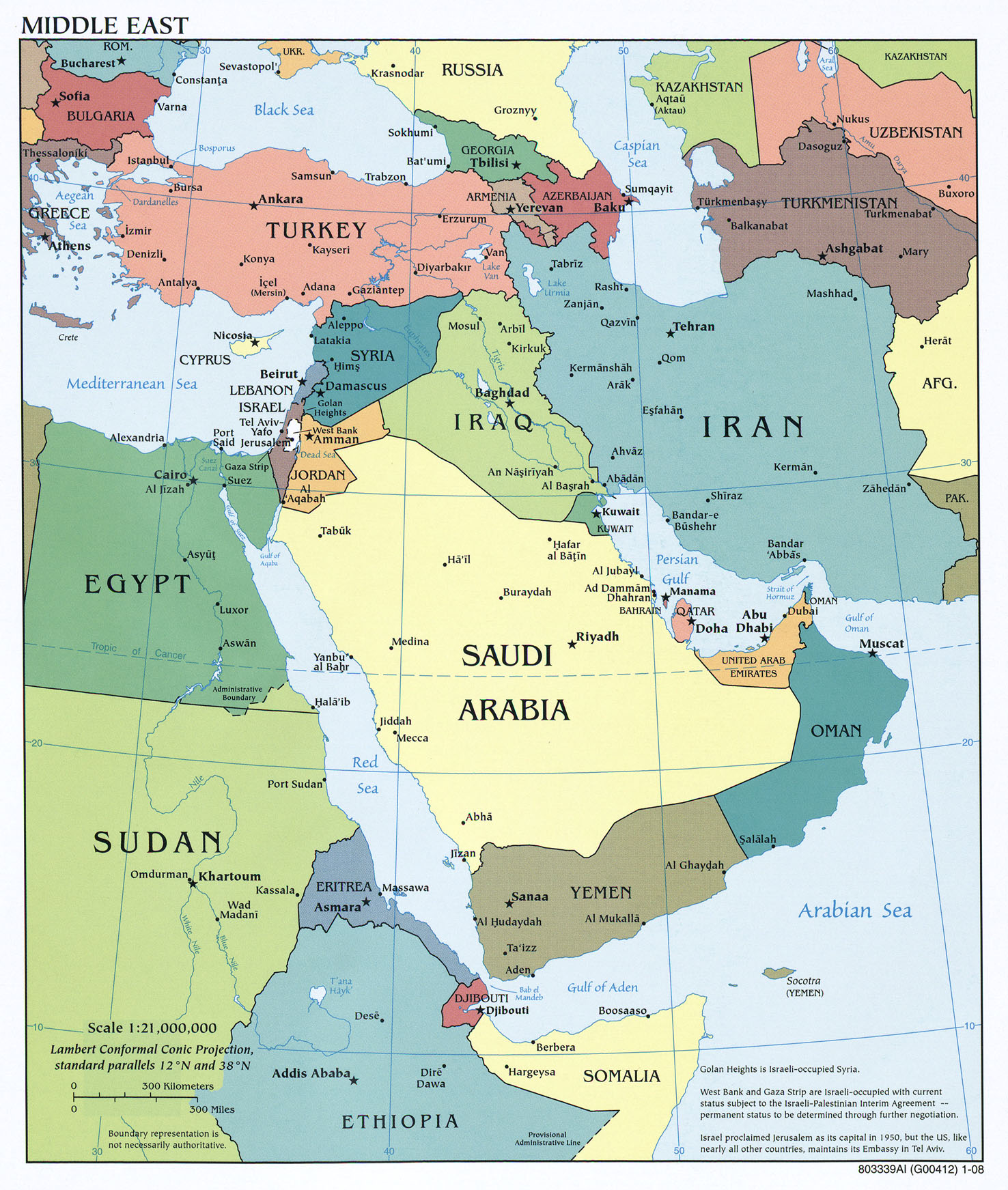
Persian Gulf & Middle East (UTex Lib. 2008)

and there are certainly major geopolitical issues in OPEC‘s Mideast and North African (MENA) member states–which is what this post is about.

The Present Saudi Pumping Surge is a Key Element of the US & EU Iran Sanctions Strategy

It is certain that the Iran confrontation will only intensify as the mid-summer sanctions deadline approaches.  By July, Washington and the EU hope to significantly curtail Iran’s ability to export oil.  In this situation, it is perhaps surprising that prices have not gone higher.

This past week, the normally understated Economist, while noting the Saudis’ extraordinary efforts to pump excess capacity, nevertheless warned that the Iran crisis could trigger a worst-ever oil shock:

Continue reading

Cracks in OPEC – Political-Economic basis for two factions with two different geopolitical roles

Northampton, MA (Area of “the five colleges,”  UMass Amhers, etc.)

On Thursday, the lead headline story in the WSJ asserted “New Cracks in Oil Cartel: OPEC Fails to Agree on Production Boost Amid Rising Saudi-Iran Tensions.”  The “cracks” may have widened at this meeting, but they are hardly “new.”  Continue reading