Category Archives: Euroepen Union

For Obama, an Iran deal trumped Syrian aid: USA “core interests” are in “flow of energy”

Geneva negotiations between P5+1 and Iran in early November (Reuters)

Geneva negotiations between P5+1 and Iran in early November (Reuters)

In September, President Obama came under withering criticism in Washington for not punishing Assad after crossing his “red line” on chemical weapons.  By October, even Riyadh had joined those in the State Department, the White House and Congress who, according to US press reports, saw Mr. Obama as “aloof” and “indecisive” on Syria.

While Mr. Obama’s refusal to arm the more democratic and secular rebel forces has indeed permitted Assad to retrench–increasing the humanitarian disaster as well as the ability of jihadi forces to insinuate themselves into the conflict– nonetheless, imagining this is due to presidential indecision ignores the realpolitik driving his policy.

Why Has Obama Not Forcefully Supported Syrian Rebels? The Iran Factor

Consider first: What if forceful US action in Syria had scuttled any talks with Iran, or, for that matter, if the present negotiations in Geneva between the P5+1 and Iran end up in failure? Continue reading

Competing with China in Latin America: Is Germany losing its high-tech advantage?

Wilfredo R. Rodriguez H., CC BYAn article I wrote for the IP Journal of the German Council on Foreign Relations is online today. It examines data on China, the EU and Germany’s trade with Latin America and the Caribbean, including in energy. Here’s a quote from near the end:

…  China’s exports to Latin America in the low-, medium-, and  high-tech categories were below those of Germany and the EU in 2003; but in 2012 [China’s exports] exceeded the combined totals of the EU15 in the medium-tech and even in the high-tech categories. The only place the EU15 surpasses China is, rather oddly, in the low-tech manufactured goods …

-> READ THE ARTICLE at GCFP’s IP Journal or Research Gate.

My talk: JFK Institute, Berlin: How “The Global Barrel” shapes Washington-EU relations

You’re invited to my lecture at The JFK Institute of North American Studies at Freie Universität in Berlin, Germany, Tuesday 6 PM. Here is the flyer, then the Abstract.  Tschüß!

ABSTRACT:

“The Global Barrel”

Today’s globalized market-centered energy system defines Washington’s relations with the EU, Japan and OPEC states Continue reading

Problems of the Global Oil System: Why teach about oil?

Oil pumpjacks in Venezuela (TalCual Digital, Caracas)

Recently, I sent off a proposal for a new course, “Problems of the Global Oil System.”  The introduction asks rhetorically: “Why Teach About Oil?”

Debates in the U.S. over oil and energy policy often resemble election campaigns, fought out with factoids and unconstrained partisanship.  Of course, deciding technical-scientific policy is inherently political.  But there are politics and there are politics.  In the proposal, I argue that  “Oil’s persistent domestic & global centrality” will extend at least another 25-to-30 years, so teaching about oil is necessary to  empower students to participate in forming energy policy democratically.

But, do the facts actually support the conclusion that petroleum’s central role in society–in both domestic and international affairs–will persist for at least 25-30 years hence?  Here is the brief argument in the introduction (and the conceptual outline of the course) for your consideration: Continue reading

Oil Prices: Saudi Pumping Surge & US-EU Iran Strategy

What are the factors driving up the price of oil? Some cite fundamentals, others over-active speculation,

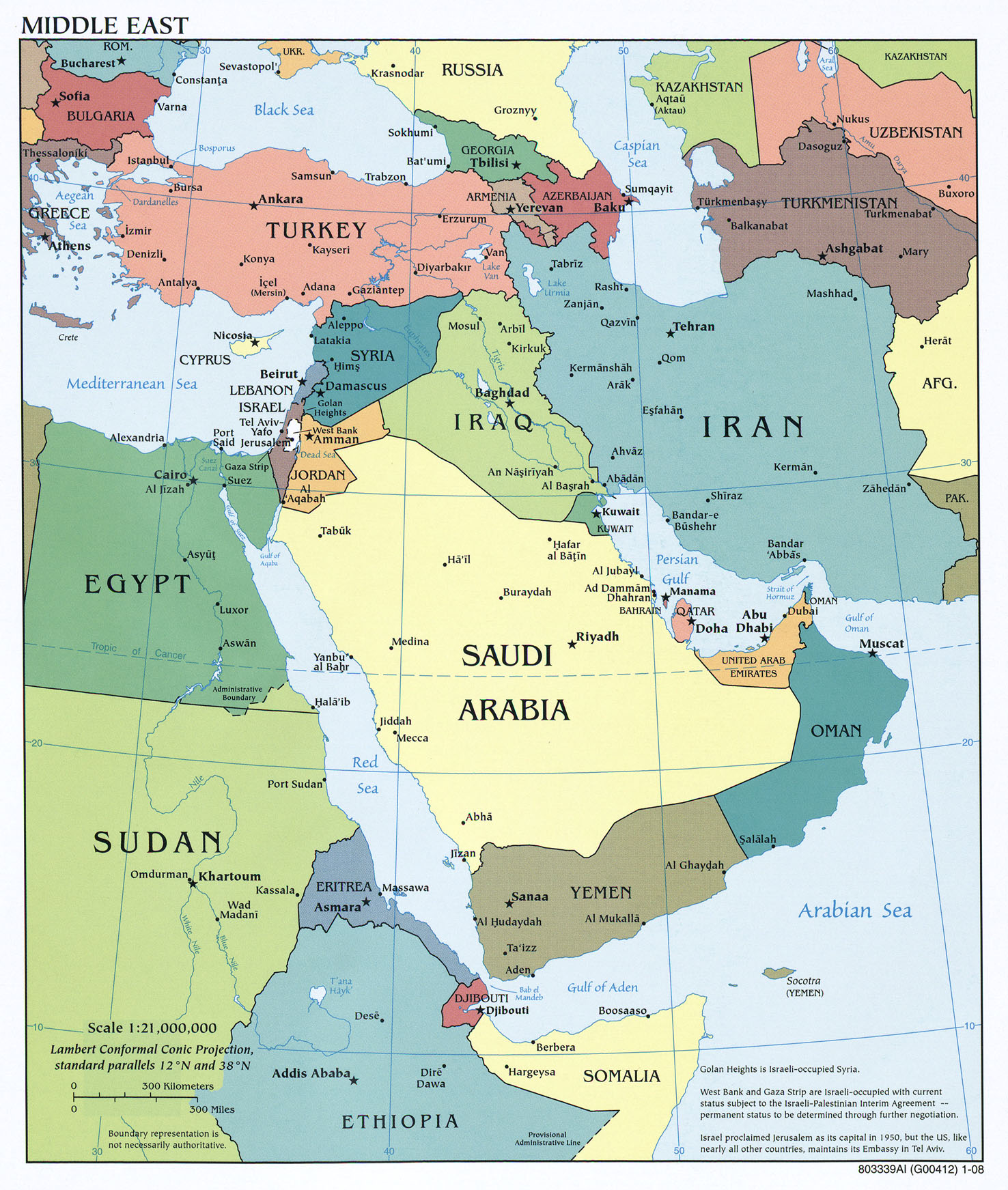
Persian Gulf & Middle East (UTex Lib. 2008)

and there are certainly major geopolitical issues in OPEC‘s Mideast and North African (MENA) member states–which is what this post is about.

The Present Saudi Pumping Surge is a Key Element of the US & EU Iran Sanctions Strategy

It is certain that the Iran confrontation will only intensify as the mid-summer sanctions deadline approaches.  By July, Washington and the EU hope to significantly curtail Iran’s ability to export oil.  In this situation, it is perhaps surprising that prices have not gone higher.

This past week, the normally understated Economist, while noting the Saudis’ extraordinary efforts to pump excess capacity, nevertheless warned that the Iran crisis could trigger a worst-ever oil shock:

Continue reading

PDVSA ships fuel to Syrian regime: Chavez risks sanctions?

[Edited Tues  630 EDT] The Negra Hipólita, a tanker operated by an affiliate of PDVSA, should be arriving at the Syrian port of Banias after a 15-17 day voyage from the Venezuelan refinery at Puerto La Cruz (El Universal, 17Feb12).

Syrian tanks are seen in Bab Amro near the city of Homs,12Feb12. Photo Reuters

Puerto La Cruz produces about 187k bbl/day and, the Negra Hipólito, if fully loaded, will deliver 47,000 (47k) tonnes of diesel fuel to alleviate reported widespread shortages of fuel in Syria. That’s about 330k barrels of fuel usable as home heating oil, or as fuel for Assad’s Russian tanks “indiscriminately” shelling neighborhoods, as in the city of Homs.  Note:

In Vienna, the U.N. chief demanded the Syrian regime stop using indiscriminate force against civilians caught up in fighting between government troops and Assad’s opponents. “We see neighborhoods shelled indiscriminately,” Ban told reporters. “Hospitals used as torture centers. Children as young as ten years old jailed and abused. We see almost certain crimes against humanity.” (Time World, Syrian Troops Shell Central City with Tanks. 17Feb12).

What, however, is the geopolitical significance of this shipment?  Let’s examine three issues:

  1. Chavez’ motivations: Why risk sanctions?
  2. Is this a significant material assistance to Assad’s regime?
  3. Has Chavez blundered by miscalculation? Continue reading

With a USA-dependent oil sector, Chavez can’t help Ahmadinejad

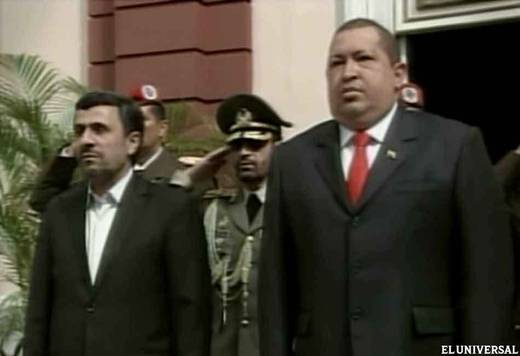
(Edited, 20 Jan.) President Ahmadinejad of Iran visited Venezuela on January 9, and then three of President Chavez’ closest Latin American allies, to search for help. His tour was part of a flurry of diplomacy in the New Year leading up to the imposition of severe new U.S. sanctions on Iran’s ability to export oil, beginning in June.

Presidents Ahmadinejad and Chavez in Caracas (Photo: El Universal)

While these two presidents met in Caracas, U.S. Treasury Secretary Geithner was visiting South Korea, Japan and China, and other U.S. officials were Continue reading

Watch my interview: The economic crisis & Impact on energy & environment

It would NOT TAKE ROCKET SCIENCE to make huge increases in energy efficiency and reduction of greenhouse gasses in the USA.   Here is an interview I gave, from Caracas in late 2009, to Erica Dingmann., on what needs to be done in transportation infrastructure and energy to REALLY make some big, practical gains in the USA.  It does NOT require big breakthroughs in technology.

Tell me what you think.