Tag Archives: Hugo Chávez

Chavez’ Legacy for Venezuela’s poor & institutions: Watch my German TV News Interview

Deutsche Welle, the German international TV service, interviewed me on the
legacy of Hugo Chavez on  their live evening news broadcast Journal  from Berlin.  I tried to relate two, strikingly contradictory aspects of President Chavez legacy:

The outpouring of sincere affection for him from the poor and many others in Caracas, which the world is witnessing, as the embodiment of their liberating political awakening.  And, in contrast, the utter shambles in which Hugo Chavez, as a practical political leader of 14 years, left the Venezuelan state and economic institutions, including PDVSA.  My segment comes at 4:08 minutes into the video stream here:

PDVSA Future Uncertain After Chavez – My views in “Platts” today

PDVSA: Reform?

Venezuela’s troubled national oil company, PDVSA — Post-Chavez Reforms ?

What’s the future of PDVSA post-Hugo Chavez?  My comments to Platts Energy writer Mery Mogollon were quoted in detail today in Oilgram News.  A JPEG  image is below (click it to enlarge).   My thanks for permission to post it here.  Continue reading

As Chavez’ oil alliance with China gets serious, Beijing holds PDVSA to its word

Groundbreaking at CNPC refinery for PDVSA heavy oil, set tol be China's largest.

Groundbreaking, PetroChina-CNPC refinery for PDVSA heavy oil. It is to be China’s largest. (April 2012)

Over the past few weeks, I have been looking at the state of the Venezuelan-Chinese oil alliance that Hugo Chavez has so fervently championed.  The picture that emerges is not what one might expect. Here is an overview, in qualitative terms. [Correction: I originally wrote Ramirez reported that PDVSA produced “60,000” new barrels of Faja oil in 2013. He actually said “20,000”.]

A. Structural Changes – Vertical Integration with China

Till now, commentators have looked primarily at the obligations of the Bolivarian Republic of Venezuela (BRV) to send oil to China to repay Beijing’s huge loans.  However, there are major changes afoot in the structure of this relationship, no matter who succeeds Hugo Chavez.  Developments on the ground in both countries show an energy infrastructure buildup will soon bring significant cross-border vertical integration.  Soon, Venezuelan oil will not be shipped to China simply to fulfill financial-and-contractual obligations, but also for locked-in infrastructural reasons. 

All indications are that the Chinese side is actively fulfilling the obligations it entered into ca. five years ago (esp. December 2007) to build oil tankers, pipelines and refineries in China in order to import and process Venezuelan heavy crude.

Continue reading

I’m cited: “(BN) Chavez Buys Enemy U.S.’s Fuel While Lauding Iran”

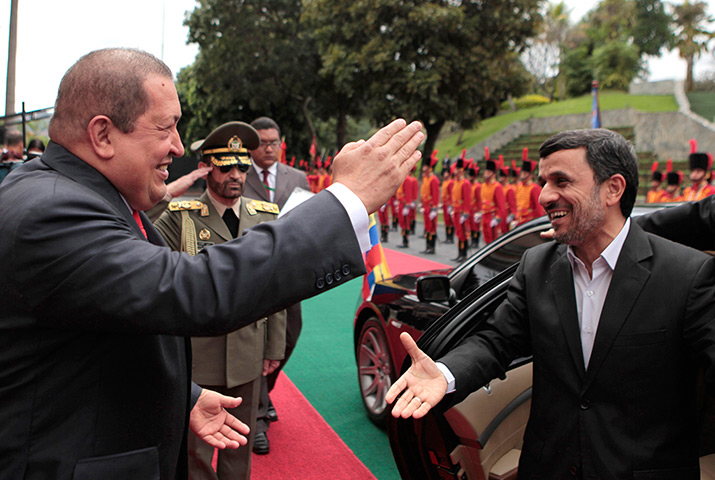
Presidents Chavez and Ahmadinejad met in Caracas in January (here) and June 2012

I was cited a number of times yesterday in a Bloomberg News article by Nathan Crooks in Caracas and Paul Burkhardt in NYC.  I reprint it below because the authors’ research further illustrates an issue I’ve often stressed here.

That is: in spite of President Chavez’ rhetoric promising to stand by Presidents Ahmadinejad of Iran (and Assad of Syria, and previously Qaddafi of Libya), he is actually in no position to withstand the U.S. sanctions that could be imposed on Venezuela for aiding Iran. Continue reading

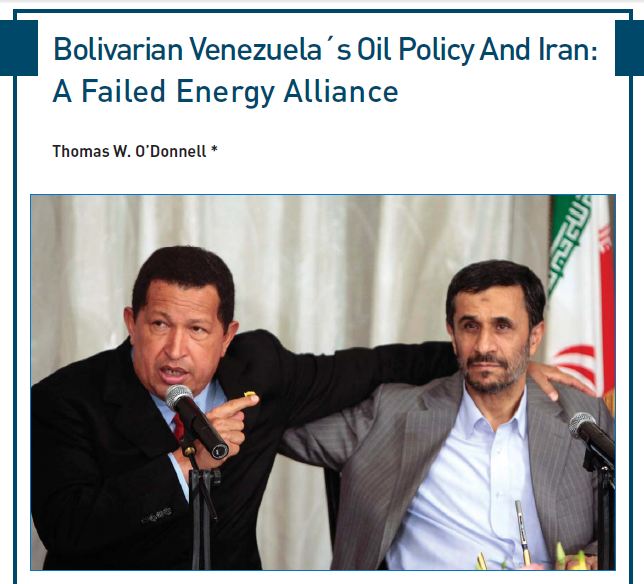
Bolivarian Venezuela’s Oil Policy & Iran: A Failed Energy Alliance

My study of Iran in Bolivarian Venezuela’s oil sector is just out in the May 2012 edition of Energy and Geopolitical Risk-published by MEES: Middle East Economic Survey.  You can read it here: Venezuela_Iran_failed_energy_alliance-Geopolitical-Risk-May-2012-3. Continue reading

PDVSA ships fuel to Syrian regime: Chavez risks sanctions?

[Edited Tues  630 EDT] The Negra Hipólita, a tanker operated by an affiliate of PDVSA, should be arriving at the Syrian port of Banias after a 15-17 day voyage from the Venezuelan refinery at Puerto La Cruz (El Universal, 17Feb12).

Syrian tanks are seen in Bab Amro near the city of Homs,12Feb12. Photo Reuters

Puerto La Cruz produces about 187k bbl/day and, the Negra Hipólito, if fully loaded, will deliver 47,000 (47k) tonnes of diesel fuel to alleviate reported widespread shortages of fuel in Syria. That’s about 330k barrels of fuel usable as home heating oil, or as fuel for Assad’s Russian tanks “indiscriminately” shelling neighborhoods, as in the city of Homs.  Note:

In Vienna, the U.N. chief demanded the Syrian regime stop using indiscriminate force against civilians caught up in fighting between government troops and Assad’s opponents. “We see neighborhoods shelled indiscriminately,” Ban told reporters. “Hospitals used as torture centers. Children as young as ten years old jailed and abused. We see almost certain crimes against humanity.” (Time World, Syrian Troops Shell Central City with Tanks. 17Feb12).

What, however, is the geopolitical significance of this shipment?  Let’s examine three issues:

  1. Chavez’ motivations: Why risk sanctions?
  2. Is this a significant material assistance to Assad’s regime?
  3. Has Chavez blundered by miscalculation? Continue reading

Chávez loses López human rights case. Part A: Venezuelan democracy & political power

Image of Leopoldo López, venezuelan politician...

Leopoldo López, former Mayor of Chacao, Caracas

(Note: this post was expanded and some corrections made 23 Sept.  Also, Part B will treat the “oil angle” – what are the policies of opposition candidates H. Capriles, P. Pérez and L. López as compared to the Chavista policies on PDVSA and on spending the nations’ oil income?)

This past week, the Inter-American Court of Human Rights overturned the administrative disqualification (inhabilitación) of Venezuelan opposition politician Leopoldo López from running as an electoral candidate. (see: decision of the Corte Interamericana de Derechos Humanos,  and press release from Lopez’ organization. )

What might be the effect on the October 2012 election?   In polls till now, Lopez has run third behind top-runner Henry Capriles, his former political ally and governor of Miranda State, and behind Pablo Pérez, the governor of Zulia State. The Chávez administration has been actively shaping who may run for the opposition ever since President Chavez’ first electoral loss, in the December 2007 plebiscite.  This decision is clearly a setback for this policy.

Continue reading

Part III: Venezuelan heavy oil: China’s persistence is finally paying off

First, here is an outline of this and the next three or four blogs on this topic:

I. Changes on the Venezuelan side that are enhancing the Chinese role:

a.  Chavez’ recent interest in increasing national oil production 

b.  The existential crisis Chavismo faces from the slow collapse of dysfunctional state institutions, civil infrastructure, and nationalized enterprises

II. Changes on China’s side that enhance its role in Venezuela:

a.  China has now loaned Venezuela so much money, and Venezuela so badly needs continued Chinese financing (lately it  also feels a need for managerial and technical assistance), that Beijing has been able to insist Caracas not only begin to come through on long-awaited heavy-oil contracts, but that it also comply with certain  geo-political and fiscal-accountability conditions. A couple of these are pretty amazing.

———————————————————————————————-

I. Changes on the Venezuelan side enhancing the Chinese role:   a. Chavez’ new interest in increasing national oil production

One reason for China’s deepening influence in Venezuela is that PDVSA‘s president and energy minister, Rafael Ramirez, is no longer alone in insisting that PDVSA’s level of production has to rise.  President Chavez now seems to have gotten behind the need to increase national production.  If the price of oil falls significantly (many feel six months at an average of $60/barrel would be ruinous) and PDVSA’s exports per day have not risen to compensate, Venezuela will be in real trouble.  Venezuela is extraordinarily dependent on imported goods, from food to machinery for which dollars are needed; and it also must keep up payments to foreign bond holders, for which a steady stream of dollars are also needed.  Chavez and Ramirez have every reason to expect that the world’s economic woes will lead to a decrease in oil demand over the next year or two, and this of course can lead to significantly lower prices.  These fears were not apparent in the recent past. It has been more or less a tenent of Chavista faith at elite-and-professional levels that the price of oil will never again fall significantly.  I have been told this many times.  Continue reading

Part II: Venezuelan heavy oil: China’s persistence is finally paying off

Major Chinese Faja heavy-oil-production contracts had not materialized till now. Why not?

(This is continued from Part I)    On the one hand, technical reasons would be given against closing deals with the Chinese. For example, it was thought by some in PDVSA that Chinese companies lacked the technology to efficiently implement the refineries needed to upgrade Venezuela‘s extra-heavy oil to a grade light enough to enable it to be accepted by foreign refineries. On this excuse, some top PDVSA executives had pressed Chinese firms to focus on making joint proposals together with, say, Total of France.  This was because Total had already proven the quality of its upgrader-refinery technology in one of the four proof-of-principle projects foreign companies had implemented during the previous government’s apertura period. (The apertura was the liberal “opening” of the oil sector to significant Continue reading

Chavez brings Venezuela’s gold home: Iranian, Libyan and Syrian factors

Why did  President Chavez last week order that Venezuela‘s gold reserves held abroad be repatriated  and that international reserve funds held in banks in the U.S., Switzerland, Britain–the global north–be moved to banks in Brazil, Russia and China–to BRIC countries?  The move is being hailed by Chavistas; but, the generalized anti-imperialist and nationalist rationals being cited are not useful as far as a specific geopolitical analysis.  That is , they do not explain why this takes place right now  as opposed to having been done at any given time during the last 12 years of his presidency.

So, why is this being done now?  The idea is obviously to keep these funds in places where they cannot be seized or frozen.  But, WHAT might trigger seizures or freezing of these funds NOW as they lay in U.S., British or Swiss banks? Continue reading

Back from Caracas & Maracaibo: Time for writing and talks

First of all, Greetings!  I have been in Venezuela during July and half of August, talking to contacts and doing research on the present situation.

I was fortunate to have had the benefit of hundreds of hours of heart-to-heart discussions with Venezuelans  from both the pro- and anti-chavista camps, both in and out of government, and some in neither camp.  I also met with several foreign reporters, business people and diplomats.  There are really not many other people from the global north in Venezuela now (I did find one grad student, from Finland). Continue reading