Category Archives: Uncategorized

With a USA-dependent oil sector, Chavez can’t help Ahmadinejad

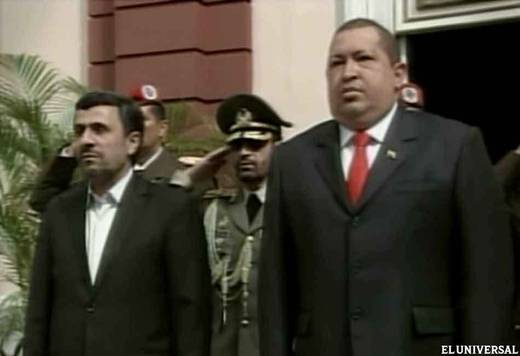
(Edited, 20 Jan.) President Ahmadinejad of Iran visited Venezuela on January 9, and then three of President Chavez’ closest Latin American allies, to search for help. His tour was part of a flurry of diplomacy in the New Year leading up to the imposition of severe new U.S. sanctions on Iran’s ability to export oil, beginning in June.

Presidents Ahmadinejad and Chavez in Caracas (Photo: El Universal)

While these two presidents met in Caracas, U.S. Treasury Secretary Geithner was visiting South Korea, Japan and China, and other U.S. officials were Continue reading

A Santos-Chavez Pipeline: Where’s the demand for Latin America’s oil boom?

President Santos of Colombia recently went to Caracas where he and PresidentChavez signed a letter of commitment  for the “Binational Project on the Venezuela-Colombia Oil Pipeline” to run 3,000 km. from Venezuela’s Faja heavy-oil region, west across Colombia to the Pacific port of Tumaco.  (El Universal and El Universal).  After many disappointments in recent years in collaborations with PDVSA, Latin American presidents haven’t endorsed many joint projects lately.  Nevertheless, Santos was beside himself with enthusiasm after the five-hour meeting on 28 November, declaring “Wherever we’ve mentioned this, people’s eyes open wide.” (Reuters)

Let’s look at some data to see if Santos and Chavez are really onto somehing here. Continue reading

Part IV: Another $6.5b in loans: The frustrated Beijing-Caracas courtship

(Greetings! It’s good to be back blogging.)  The common perception is that Chinese oil companies in Venezuela are winning big deals on very favorable terms.  However, as I’ve stressed in previous posts, Beijing is actually very frustrated not to be getting the deals it expects for new Faja heavy oil fields, especially considering its big investments in the Bolivarian state.  More evidence continues to emerge.

From 21-23 November the “10th Meeting of the China-Venezuela High-Level Committee” took place in Caracas at the Hotel Gran Meliá, with something like 400 businesses and state representatives coming from China.    Continue reading

Chávez loses López human rights case. Part A: Venezuelan democracy & political power

Image of Leopoldo López, venezuelan politician...

Leopoldo López, former Mayor of Chacao, Caracas

(Note: this post was expanded and some corrections made 23 Sept.  Also, Part B will treat the “oil angle” – what are the policies of opposition candidates H. Capriles, P. Pérez and L. López as compared to the Chavista policies on PDVSA and on spending the nations’ oil income?)

This past week, the Inter-American Court of Human Rights overturned the administrative disqualification (inhabilitación) of Venezuelan opposition politician Leopoldo López from running as an electoral candidate. (see: decision of the Corte Interamericana de Derechos Humanos,  and press release from Lopez’ organization. )

What might be the effect on the October 2012 election?   In polls till now, Lopez has run third behind top-runner Henry Capriles, his former political ally and governor of Miranda State, and behind Pablo Pérez, the governor of Zulia State. The Chávez administration has been actively shaping who may run for the opposition ever since President Chavez’ first electoral loss, in the December 2007 plebiscite.  This decision is clearly a setback for this policy.

Continue reading

Part I: Venezuelan heavy oil: China’s persistence is finally paying off

In my travels and interviews in Venezuela this summer, it became clear that there has been a major advance in the relationship between China and the Bolivarian administration of President Chavez.  China’s dogged persistence and large state-sponsored investments in Venezuela – apparently the largest they’ve made to date in any country – are finally beginning to bear fruit.  The new Chinese influence is being simultaneously extended to both oil and non-oil sectors. 

Partly this development is due to the many crises affecting the Bolivarian state, and decisions it has been forced to take to make increasing national oil production a priority.  To advance this program, President Chavez’ administration has made initial moves to grant Beijing access to Venezuelan oil in major ways it had not previously. 

However, there are two sides to this story: on the other side, increasing Chinese participation is also a product of China having step-by-step put some quite sharp demands on PDVSA and the Venezuelan Bolivarian state for financial transparency and accountability, for geopolitical stabilization, and in particular, for Chinese firms being granted large-scale access to new heavy-oil fields in the Faja of the Orinoco River.  The key ingredient here is that Continue reading