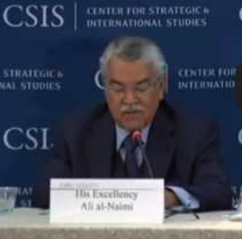
Al-Naimi at CSIS
Last week in Washington, I attended a talk by Saudi Oil Minister and head of Aramco, Ali al-Naimi, at CSIS. Energy and foreign policy veterans from Daniel Yergin to Brent Scowcroft and Dr. James Schlesinger were on hand to hear al-Naimi’s views. You can read the transcript here, or watch the video embedded below.
Al-Naimi’s contrasted his central theme: “the enduring relevance of oil,” to the predictions made for many years by the adherents of “peak oil”–a theory that he said had itself “peaked in 2009” and has now been shown to be “utterly incorrect.”
Bad News for Venezuela and Iran?
Listening to him describe the global impact that the U.S.A. tight-oil “revolution” will have on the market, plus with Alberta’s heavy oil and so many other new sources from around the globe all coming to market, brought to my mind images of the 1980’s. The 1980’s were the “lost decade” in Latin America. It strikes me that, if he’s right about the trajectory of the global oil sector, the consequences for OPEC’s “price hawk” faction would be sobering. Continue reading →
Posted in Aramco, China, Economic Crisis, Energy and Environment, Faja of the Orinoco, heavy oil, international relations, Iran sanctions, Oil prices, Oil supply, OPEC, PDVSA, PDVSA weakness, Peak Oil, Persian Gulf, Resource conflicts, Sanctions, Saudi Arabit, shale oil, The USA, Tight oil, U.S. oil, Venezuelan weak institutions
Tagged Al-Naimi, Ali Al-Naimi, Brent Scowcroft, Daniel Yergin, Saudi, Saudi Arabia, United States, Washington

 For Spanish speakers: below is an article from Tal Cual daily in Venezuela summarizing
 The Global Barrel