Category Archives: PDVSA

Chavez’ Legacy for Venezuela’s poor & institutions: Watch my German TV News Interview

Deutsche Welle, the German international TV service, interviewed me on the
legacy of Hugo Chavez on  their live evening news broadcast Journal  from Berlin.  I tried to relate two, strikingly contradictory aspects of President Chavez legacy:

The outpouring of sincere affection for him from the poor and many others in Caracas, which the world is witnessing, as the embodiment of their liberating political awakening.  And, in contrast, the utter shambles in which Hugo Chavez, as a practical political leader of 14 years, left the Venezuelan state and economic institutions, including PDVSA.  My segment comes at 4:08 minutes into the video stream here:

PDVSA Future Uncertain After Chavez – My views in “Platts” today

PDVSA: Reform?

Venezuela’s troubled national oil company, PDVSA — Post-Chavez Reforms ?

What’s the future of PDVSA post-Hugo Chavez?  My comments to Platts Energy writer Mery Mogollon were quoted in detail today in Oilgram News.  A JPEG  image is below (click it to enlarge).   My thanks for permission to post it here.  Continue reading

As Chavez’ oil alliance with China gets serious, Beijing holds PDVSA to its word

Groundbreaking at CNPC refinery for PDVSA heavy oil, set tol be China's largest.

Groundbreaking, PetroChina-CNPC refinery for PDVSA heavy oil. It is to be China’s largest. (April 2012)

Over the past few weeks, I have been looking at the state of the Venezuelan-Chinese oil alliance that Hugo Chavez has so fervently championed.  The picture that emerges is not what one might expect. Here is an overview, in qualitative terms. [Correction: I originally wrote Ramirez reported that PDVSA produced “60,000” new barrels of Faja oil in 2013. He actually said “20,000”.]

A. Structural Changes – Vertical Integration with China

Till now, commentators have looked primarily at the obligations of the Bolivarian Republic of Venezuela (BRV) to send oil to China to repay Beijing’s huge loans.  However, there are major changes afoot in the structure of this relationship, no matter who succeeds Hugo Chavez.  Developments on the ground in both countries show an energy infrastructure buildup will soon bring significant cross-border vertical integration.  Soon, Venezuelan oil will not be shipped to China simply to fulfill financial-and-contractual obligations, but also for locked-in infrastructural reasons. 

All indications are that the Chinese side is actively fulfilling the obligations it entered into ca. five years ago (esp. December 2007) to build oil tankers, pipelines and refineries in China in order to import and process Venezuelan heavy crude.

Continue reading

Venezuelan Succession Crisis? 1: Two men Chavez wants to succeed him

A succession crisis is stalking Venezuelan society. cabello-venezuela--644x362President Chavez of Venezuela is again in Havana, after a complex six-hour surgery, his third in a year for an unspecified form of cancer. Just before the surgery, he returned to Caracas to address the nation. For the first time he spoke about what he wishes to be done if he is unable to return to the presidency.   Continue reading

Amuay refinery disaster: Syrian naphtha & Chavez’ “petroleum revolution” in flames

“Methane gas at 24%, H2S gas (hydrogen sulfide) 4%. We’re dying.” 

Late Friday night, 24 August, Rigoberto Colina García, a 29-year-old worker at a lubricant company just outside the Amuay Refinery compound in Venezuela’s Falcon State, had sent this message on his Blackberry. (La República, 28Aug12)  Some hours later, at 1:11 AM Saturday, a tremendous explosion killed over 40 people sleeping or working in buildings beyond the refinery’s perimeter, including Rigoberto and four of his co-workers.

This is the worst disaster in Venezuela’s modern oil history, and one of the worst refinery accidents ever worldwide.  This week, across Venezuela, President Chavez and PDVSA leadership have been targets of public criticism and outrage.

Clearly, industrial and political policies of PDVSA and the Venezuelan state contributed to this disaster.  Meanwhile, yesterday I found a somewhat tangential, but particularly unseemly fact.  It seems that President Chavez’ only recent involvement with Amuay in the months preceding this disaster had nothing to do with improving the productivity of the facility, much less the safety of workers and neighboring citizens. No, rather, his involvement was a scheme to bolster PDVSA’s  material support for the dictatorial regime of Syria’s Assad in suppressing the popular revolution there.  This scheme apparently accounts for the origin of some of the naphtha that burned for four days following the explosion.  But first, the facts of the disaster, in so far as they are known. Continue reading

I’m cited: “(BN) Chavez Buys Enemy U.S.’s Fuel While Lauding Iran”

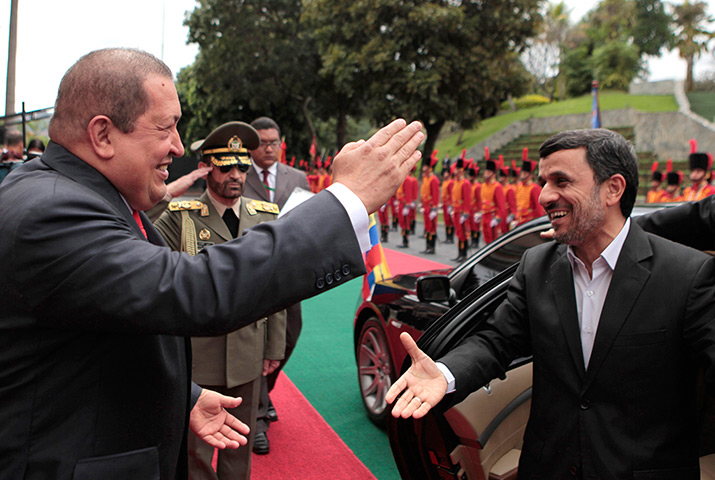
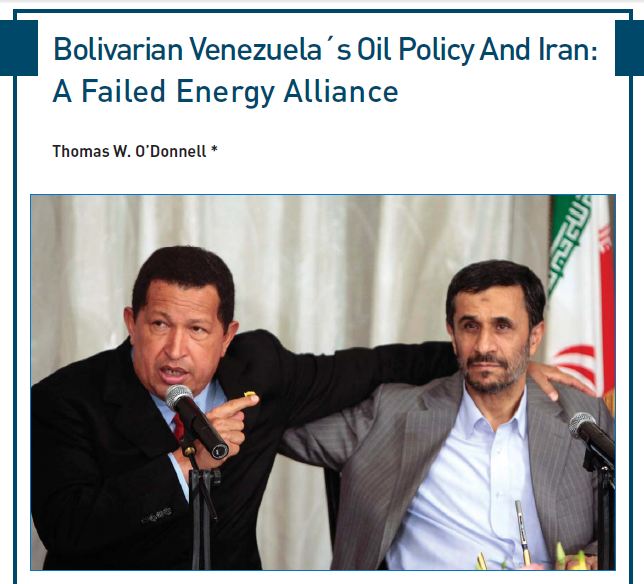
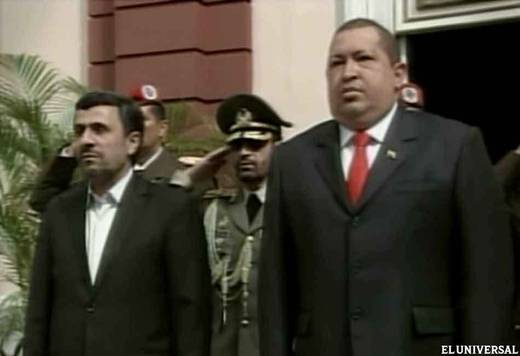
Presidents Chavez and Ahmadinejad met in Caracas in January (here) and June 2012

I was cited a number of times yesterday in a Bloomberg News article by Nathan Crooks in Caracas and Paul Burkhardt in NYC.  I reprint it below because the authors’ research further illustrates an issue I’ve often stressed here.

That is: in spite of President Chavez’ rhetoric promising to stand by Presidents Ahmadinejad of Iran (and Assad of Syria, and previously Qaddafi of Libya), he is actually in no position to withstand the U.S. sanctions that could be imposed on Venezuela for aiding Iran. Continue reading

Venezuelan Faja Surprise: USA’s Harvest sells not to China but Indonesia

Petrodelta,SA rig in the south of Monagas state, Venezuela (PDVSA 2011 Annual Rept)

In March, U.S.-based Harvest Natural Resources (HNR) had disclosed to shareholders it was in exclusive confidential negotiations with a national oil company (NOC) to sell its 32% stake in Petrodelta SA–a lucrative, mature, medium-heavy Faja oil field in the south of Monagas state, in which PDVSA holds a 60% share.  Thursday evening, Harvest surprised observers by announcing they had signed an agreement with the Indonesian National Oil company, Pertamina.

The big question immediately being asked was: “Indonesia?  Why not China?”  I was quoted at length Friday morning on this question by Bloomberg’s Nathan Crooks in Caracas (See:

Continue reading

Iranian National Oil Company & PDVSA Respond to My Exposé?!

A curious announcement in The Tehran Times: “Tehran, Caracas to ink $2 billion oil deal soon” (29 May, web 30 May) followed on the heels of my exposé about this relationship that was published just two weeks prior.  The Tehran Times’ piece was brought to my attention by James Bourne, Senior Latin American Editor at Energy Intelligence NYC, who requested a comment.  Energy Intelligence has kindly provided GlobalBarrel.com a PDF of Bourne’s piece in their subscriber-only Oil Daily of 31 May, which you can read at this link: Continue reading

My Iran-in-Venezuelan-Oil Study: Summarized in “Tal Cual” today in Caracas; in Spanish

For those who read Spanish:  Today Tal Cual in Caracas carried a detailed summary in Spanish by Jose Suárez Núñez of my study, “Bolivarian Venezuela’s Oil Policy & Iran: A Failed Energy Alliance” (which appeared in Middle East Economic Survey’s [MEES] Energy and Geopolitical Risk for May 2012).

Suárez Núñez is the Tal Cual oil columnist, and one of Venezuela´s most senior oil journalists.  Here are the links: Continue reading

Bolivarian Venezuela’s Oil Policy & Iran: A Failed Energy Alliance

My study of Iran in Bolivarian Venezuela’s oil sector is just out in the May 2012 edition of Energy and Geopolitical Risk-published by MEES: Middle East Economic Survey.  You can read it here: Venezuela_Iran_failed_energy_alliance-Geopolitical-Risk-May-2012-3. Continue reading

PDVSA ships fuel to Syrian regime: Chavez risks sanctions?

[Edited Tues  630 EDT] The Negra Hipólita, a tanker operated by an affiliate of PDVSA, should be arriving at the Syrian port of Banias after a 15-17 day voyage from the Venezuelan refinery at Puerto La Cruz (El Universal, 17Feb12).

Syrian tanks are seen in Bab Amro near the city of Homs,12Feb12. Photo Reuters

Puerto La Cruz produces about 187k bbl/day and, the Negra Hipólito, if fully loaded, will deliver 47,000 (47k) tonnes of diesel fuel to alleviate reported widespread shortages of fuel in Syria. That’s about 330k barrels of fuel usable as home heating oil, or as fuel for Assad’s Russian tanks “indiscriminately” shelling neighborhoods, as in the city of Homs.  Note:

In Vienna, the U.N. chief demanded the Syrian regime stop using indiscriminate force against civilians caught up in fighting between government troops and Assad’s opponents. “We see neighborhoods shelled indiscriminately,” Ban told reporters. “Hospitals used as torture centers. Children as young as ten years old jailed and abused. We see almost certain crimes against humanity.” (Time World, Syrian Troops Shell Central City with Tanks. 17Feb12).

What, however, is the geopolitical significance of this shipment?  Let’s examine three issues:

  1. Chavez’ motivations: Why risk sanctions?
  2. Is this a significant material assistance to Assad’s regime?
  3. Has Chavez blundered by miscalculation? Continue reading

With a USA-dependent oil sector, Chavez can’t help Ahmadinejad

(Edited, 20 Jan.) President Ahmadinejad of Iran visited Venezuela on January 9, and then three of President Chavez’ closest Latin American allies, to search for help. His tour was part of a flurry of diplomacy in the New Year leading up to the imposition of severe new U.S. sanctions on Iran’s ability to export oil, beginning in June.

Presidents Ahmadinejad and Chavez in Caracas (Photo: El Universal)

While these two presidents met in Caracas, U.S. Treasury Secretary Geithner was visiting South Korea, Japan and China, and other U.S. officials were Continue reading

A Santos-Chavez Pipeline: Where’s the demand for Latin America’s oil boom?

President Santos of Colombia recently went to Caracas where he and PresidentChavez signed a letter of commitment  for the “Binational Project on the Venezuela-Colombia Oil Pipeline” to run 3,000 km. from Venezuela’s Faja heavy-oil region, west across Colombia to the Pacific port of Tumaco.  (El Universal and El Universal).  After many disappointments in recent years in collaborations with PDVSA, Latin American presidents haven’t endorsed many joint projects lately.  Nevertheless, Santos was beside himself with enthusiasm after the five-hour meeting on 28 November, declaring “Wherever we’ve mentioned this, people’s eyes open wide.” (Reuters)

Let’s look at some data to see if Santos and Chavez are really onto somehing here. Continue reading

Part IV: Another $6.5b in loans: The frustrated Beijing-Caracas courtship

(Greetings! It’s good to be back blogging.)  The common perception is that Chinese oil companies in Venezuela are winning big deals on very favorable terms.  However, as I’ve stressed in previous posts, Beijing is actually very frustrated not to be getting the deals it expects for new Faja heavy oil fields, especially considering its big investments in the Bolivarian state.  More evidence continues to emerge.

From 21-23 November the “10th Meeting of the China-Venezuela High-Level Committee” took place in Caracas at the Hotel Gran Meliá, with something like 400 businesses and state representatives coming from China.    Continue reading

Chávez loses López human rights case. Part A: Venezuelan democracy & political power

Image of Leopoldo López, venezuelan politician...

Leopoldo López, former Mayor of Chacao, Caracas

(Note: this post was expanded and some corrections made 23 Sept.  Also, Part B will treat the “oil angle” – what are the policies of opposition candidates H. Capriles, P. Pérez and L. López as compared to the Chavista policies on PDVSA and on spending the nations’ oil income?)

This past week, the Inter-American Court of Human Rights overturned the administrative disqualification (inhabilitación) of Venezuelan opposition politician Leopoldo López from running as an electoral candidate. (see: decision of the Corte Interamericana de Derechos Humanos,  and press release from Lopez’ organization. )

What might be the effect on the October 2012 election?   In polls till now, Lopez has run third behind top-runner Henry Capriles, his former political ally and governor of Miranda State, and behind Pablo Pérez, the governor of Zulia State. The Chávez administration has been actively shaping who may run for the opposition ever since President Chavez’ first electoral loss, in the December 2007 plebiscite.  This decision is clearly a setback for this policy.

Continue reading