Category Archives: Hugo Chávez

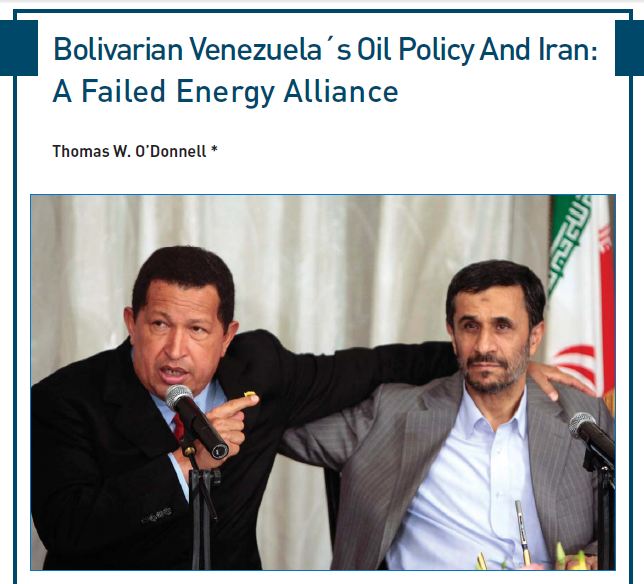
Bolivarian Venezuela’s Oil Policy & Iran: A Failed Energy Alliance

My study of Iran in Bolivarian Venezuela’s oil sector is just out in the May 2012 edition of Energy and Geopolitical Risk-published by MEES: Middle East Economic Survey.  You can read it here: Venezuela_Iran_failed_energy_alliance-Geopolitical-Risk-May-2012-3. Continue reading

PDVSA ships fuel to Syrian regime: Chavez risks sanctions?

[Edited Tues  630 EDT] The Negra Hipólita, a tanker operated by an affiliate of PDVSA, should be arriving at the Syrian port of Banias after a 15-17 day voyage from the Venezuelan refinery at Puerto La Cruz (El Universal, 17Feb12).

Syrian tanks are seen in Bab Amro near the city of Homs,12Feb12. Photo Reuters

Puerto La Cruz produces about 187k bbl/day and, the Negra Hipólito, if fully loaded, will deliver 47,000 (47k) tonnes of diesel fuel to alleviate reported widespread shortages of fuel in Syria. That’s about 330k barrels of fuel usable as home heating oil, or as fuel for Assad’s Russian tanks “indiscriminately” shelling neighborhoods, as in the city of Homs.  Note:

In Vienna, the U.N. chief demanded the Syrian regime stop using indiscriminate force against civilians caught up in fighting between government troops and Assad’s opponents. “We see neighborhoods shelled indiscriminately,” Ban told reporters. “Hospitals used as torture centers. Children as young as ten years old jailed and abused. We see almost certain crimes against humanity.” (Time World, Syrian Troops Shell Central City with Tanks. 17Feb12).

What, however, is the geopolitical significance of this shipment?  Let’s examine three issues:

  1. Chavez’ motivations: Why risk sanctions?
  2. Is this a significant material assistance to Assad’s regime?
  3. Has Chavez blundered by miscalculation? Continue reading

With a USA-dependent oil sector, Chavez can’t help Ahmadinejad

(Edited, 20 Jan.) President Ahmadinejad of Iran visited Venezuela on January 9, and then three of President Chavez’ closest Latin American allies, to search for help. His tour was part of a flurry of diplomacy in the New Year leading up to the imposition of severe new U.S. sanctions on Iran’s ability to export oil, beginning in June.

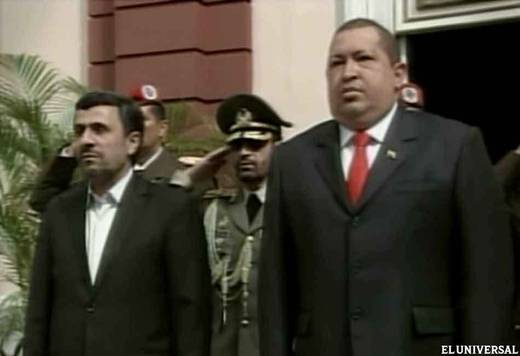
Presidents Ahmadinejad and Chavez in Caracas (Photo: El Universal)

While these two presidents met in Caracas, U.S. Treasury Secretary Geithner was visiting South Korea, Japan and China, and other U.S. officials were Continue reading

A Santos-Chavez Pipeline: Where’s the demand for Latin America’s oil boom?

President Santos of Colombia recently went to Caracas where he and PresidentChavez signed a letter of commitment  for the “Binational Project on the Venezuela-Colombia Oil Pipeline” to run 3,000 km. from Venezuela’s Faja heavy-oil region, west across Colombia to the Pacific port of Tumaco.  (El Universal and El Universal).  After many disappointments in recent years in collaborations with PDVSA, Latin American presidents haven’t endorsed many joint projects lately.  Nevertheless, Santos was beside himself with enthusiasm after the five-hour meeting on 28 November, declaring “Wherever we’ve mentioned this, people’s eyes open wide.” (Reuters)

Let’s look at some data to see if Santos and Chavez are really onto somehing here. Continue reading

Part IV: Another $6.5b in loans: The frustrated Beijing-Caracas courtship

(Greetings! It’s good to be back blogging.)  The common perception is that Chinese oil companies in Venezuela are winning big deals on very favorable terms.  However, as I’ve stressed in previous posts, Beijing is actually very frustrated not to be getting the deals it expects for new Faja heavy oil fields, especially considering its big investments in the Bolivarian state.  More evidence continues to emerge.

From 21-23 November the “10th Meeting of the China-Venezuela High-Level Committee” took place in Caracas at the Hotel Gran Meliá, with something like 400 businesses and state representatives coming from China.    Continue reading

Chávez loses López human rights case. Part A: Venezuelan democracy & political power

Image of Leopoldo López, venezuelan politician...

Leopoldo López, former Mayor of Chacao, Caracas

(Note: this post was expanded and some corrections made 23 Sept.  Also, Part B will treat the “oil angle” – what are the policies of opposition candidates H. Capriles, P. Pérez and L. López as compared to the Chavista policies on PDVSA and on spending the nations’ oil income?)

This past week, the Inter-American Court of Human Rights overturned the administrative disqualification (inhabilitación) of Venezuelan opposition politician Leopoldo López from running as an electoral candidate. (see: decision of the Corte Interamericana de Derechos Humanos,  and press release from Lopez’ organization. )

What might be the effect on the October 2012 election?   In polls till now, Lopez has run third behind top-runner Henry Capriles, his former political ally and governor of Miranda State, and behind Pablo Pérez, the governor of Zulia State. The Chávez administration has been actively shaping who may run for the opposition ever since President Chavez’ first electoral loss, in the December 2007 plebiscite.  This decision is clearly a setback for this policy.

Continue reading