
[TWO “discoveries” just after this interview:
First, Bloomberg reported Ukraine had destroyed an oil pumping station on the pipeline feeding Russia’s big Ust Luga oil export terminal on the Baltic Sea. This is the first time Kyiv has shutdown a Russian oil port, … which is exactly what I advocated in the interview above and since early-2024 as a military tactic to accompany imposition of “real” USA-EU oil sanctions on the three Russian west-facing oil ports, replacing the failed “oil price cap” policy.
Second, Christof Ruhl, former-BP VP, and -World Bank Moscow rep., now at the Columbia U. Energy Center, had an OP-ED in the FT, with a similar argument that Russian oil can be replaced with OPEC crude. I recommend it: “Trump should call on Opec in his bid to negotiate with Putin Ukraine’s western allies must join forces with the oil cartel to really squeeze Russia’s war economy” Christof Ruhl, 30jan25.]
There are two topics in this interview with Diana Skya of Poland’s national broadcaster, TVP:
- Putin’s oil export income can be slashed via new sanctions and military policies, in line with Trump’s interest in forcing a “deal”
- EU member states that seek a new Putin gas partnership are dysfunctionally replaying Merkel-ism and avoiding the real solution of reforming the Green Deal to put nuclear energy in the center. (See: “EU debates return to Russian gas as part of Ukraine peace deal. Advocates say reopening pipelines could help settlement with Moscow and cut energy costs” Henry Foy and Alice Hancock in Brussels and Christopher Miller in Kyiv, FT, 30jan25)
- OIL SANCTIONS:
I have argued for three years that the rationale behind the USA-EU imposition of a Russian “oil-price cap” rather than simply imposing real oil sanctions has been flawed, and the policy has failed.
It was conceived in early-2022, apparently by former-central-banker Mario Draghi of Italy and taken up by then-USA-Treasury-head Janet Yellen, neither of whom understood global oil trade sufficiently to see how easily the Russians could get around this scheme, as they have with a “shadow fleet” of oil tankers insured by Chinese, Russian or other non-EU, non-UK firms.
What I have advocated, is to replace the complex price-cap policy with a combination of simple USA-EU oil sanctions against any ships that leave Russia’s three westward-facing oil ports, while simultaneously permitting Ukrainians to attack these terminals. This combination could slash roughly 2 million barrels per day (mbd) of Russian exports, and devastate Russia’s state budget – and its war-making capacity. (see Bloomberg chart below of export volumes from these three ports over time).
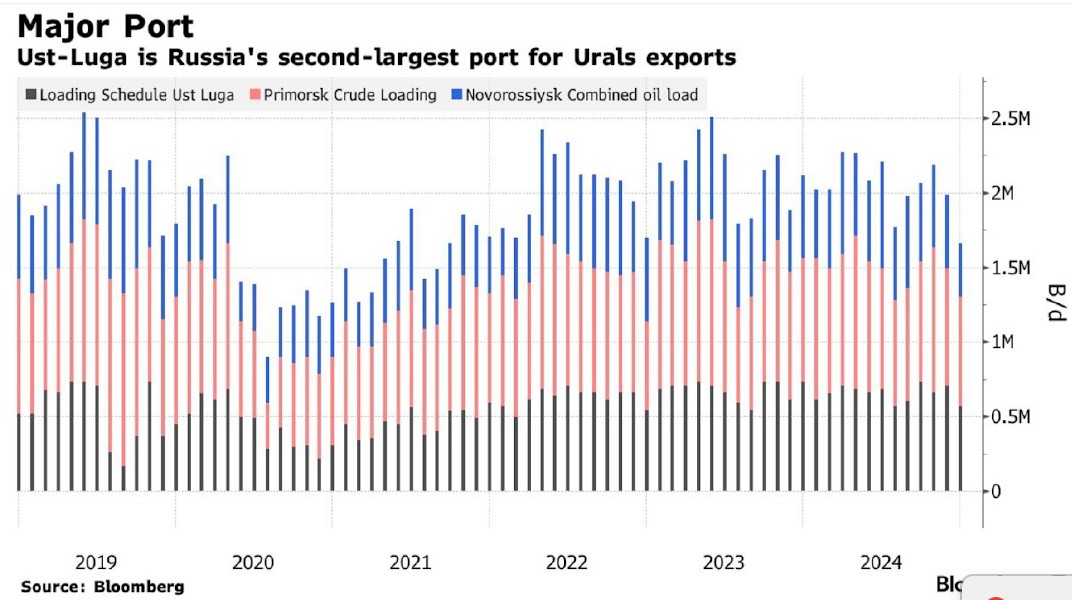
And, just last week, for the first time Ukraine has hit an oil pumping station for one of these ports, apparently shutting its exports. (See: “Oil Flow Through Russia’s Ust-Luga Appears to Pause After Attack. Russia,” by Sherry Su, Blumberg, 30jan25.) .
To see how impactful blocking ca. 2 mbd of exports might be (a new normal for these ports might be lower now, 1.8 or so). According to reports, in 2024 Russia exported ca. 4.8 mbd*.
* Aside 1.0: Russian energy minister Novak, according to Reuters, says RU exported 240 Million tonnes (MT) of oil in 2024. So:
240 * 7.34 (barrels/tonne [i.e., averaging this 7.46 and this 7.25 reference]) / 365 (days/yr) = 4.8 mbd, Then, 2/4.8 is ca. 32%-to-37% of Russian exports.
This Reuters article further quotes Novak, “… Due to rising prices for Russian oil, the share of oil and gas revenues in the federal budget in 2024 amounted to about 30%.” In addition, the revenues from oil and refined produces exports in 2024 were reported (Statista.com) as €576.41 b, and from gas pipelines and LNG as €172.92 b. Thus oil-and-refined products were ca. 77% of total oil and gas revenues. So that a loss of, say 34% of oil revenues would produce a loss of almost €200b state revenues, or over 25%.
This is what is known in Texas as “real money.” It is also consistent with a rough estimate I referred to in the interview, a Russian opposition leaders’ quick calculation that this might deprive Moscow of roughly “15%” of state export revenues over a year, causing “real pain.”
Further, given oil market conditions, this could be done without causing the feared spike in global oil prices, (it is difficult whether the Biden or Trump administrations have feared this more), which is what motivated the timid oil-price cap policy rather than old-fashioned oil sanctions in the first place.
Aside 2.0: Why this needs not to spike prices: Some months Post-Corona, a condition developed in the market of excess supply capacity on soft demand. This means OPEC has plenty of barrels being held offline since 2023, in a market so soft this has not brought prices up as it hoped, still hovering in the $70s-to-low-$80s per barrel range.
Looking at the numbers, OPEC took 1.65 million barrels per day (mbd) offline in April 2023, and another 2.2 mbd in November 2023. Meanwhile, including its OPEC+ partners, there are a total of almost 6 mbd offline (this including Russian cuts).
In a third category, “… non-OPEC+ supply is set to grow this year, too, led by the U.S., Brazil, Guyana, Canada, and Argentina. This growth could be enough to meet the expected growth in global oil demand, …” (OilPrice.com 16jan25) So, 2 mbd of Russian crude can be easily replaced. And, I’d add, that if the USA administration signals that such a removal will be very long term, then USA frackers and others would likely be enticed to eventually expand production as Trump has repeatedly advocated.
The three west-facing Russian oil-export terminals that should be sanctioned (i.e., any ship leaving should be subject to sanctions as well as any future port-of-call, or any entity insuring, financing or servicing it, etc.) include:
- Ust Luga on the southern shore of the Gulf of Finalnd and
- Primorsk on the northern shore of the Gulf of Finland, at the eastern extremity of the Baltic Sea, and
- Novorossiysk, the huge Russian port on the northeast side the Black Sea
The Ukrainians, it is important to note, have obviously long been capable of hitting the oil-export infrastructure of these ports. I say “obviously” because, for almost a year they have already been hitting their environs, however never hitting anything that would stop the export of Russian oil, not until last Thursday. If this Ust Luga attack on the port’s oil-export capacity is repeated and extended to the other two west-facing oil ports, this would devastate the Russian economy even without any new USA sanctions on exports. This might be what develops.
It will be instructive to see if the Trump administration accepted such a development or if it seeks to restrain the Ukrainians out of fear of any increase in domestic USA gasoline prices, as was so feared by the Biden administration . However, if Trump’s priority is to really hurt Putin’s war effort, in order to force negotiations to end the war, this development may be welcomed — particularly if the administration understands there is no need for it to cause any spike in prices if handled carefully with OPEC and various oil-producing allies
Aside 3.0 Of course, Russia might retaliate on USA or EU oil and gas infrastructure. Recall, for example, the capacity demonstrated in May 2021, when Russian hackers shut the USA Colonial Pipeline system, stopping up to 45% of diesel and jet fuel supplied to locations between Texas and New York City for six days, and extorting a bitcoin payment, causing President Biden to declare a national emergency. Note also the recent spate of cutting of Baltic Sea gas pipelines and communications cables by ships leaving Russian ports that have dragged their anchors. The question will be what will the Trump administration prioritize.
As a USA energy consultancy remarked in a report to clients in mid-2024, the Ukrainians were refraining from hitting these oil-export facilities, presumably “out of deference to the Americans,” who had not wanted to risk blocking any Russian oil exports. Such fears have been unfounded, as I try to demonstrate above with some figures of the amount of oil held offline by OPEC and OPEC+ (see Aside 2.0 ).
In addition, closing the bulk of this export flow from the old West Urals fields would force Russian to severely throttle the output of these fields, as Russia has no significant national crude oil storage facilities to absorb it. Some output could be transferred to other pipelines and perhaps find other, partial outlets, but if all these three ports are largely offline at once, the result would be that many fields would either have to be shut off or curtail production to a trickle, permanently or severely damaging the fields (see Aside 4.0).
Aside 4.0 The problem is these old West-Urals, Siberian fields require constant application of sophisticated “enhanced oil recovery” (EOR) techniques, injecting water around the reservoir in a calculated manner that keeps forcing the viscus oil below to flow despite the loss of nearly all intrinsic pressure in the significantly depleted underground reservoirs and due to the low ambient temperature as oil approaches the surface of this Siberian region.
If these fields were ever completely shut off it would be extremely difficult or impossible to get the oil flowing again near the former volumes or in some cases perhaps at all, as the stopped crude oil below ground would “wax up” In analogy to a percolation model of fluid flow through a porous media (here the underground rock pores and cracks), the fluid’s surface tension increases as flow is halted, becoming much higher than for flowing fluid and must be overcome by external pressure, from injecting high pressure water in a judicious manner, in order to renew flow.
There is plenty of spare production being held off market by OPEC and its OPEc+ partners to replace this amount of Russian barrels. Done intelligently and cooperatively with OPEC, especially with the Saudis and UAE, any significant spike in oil prices should be avoidable as the gradually lost Russian market share is taken over, in sync, by OPEC, by American frackers, and various non-OPEC producers (especially Brazil and Guyana). It is all do-able.
Date shows this to have been a possible strategy for at least the past ca. 1.5 years, with oil production held off the market by OPEC and its OPEC+ partners. However, demand has been so soft (e.g., in China and the EU) that OPEC+ holding almost 6 mbd offline has only held the price generally in the $70s/barrel, at times low $80s, at least avoiding a fall to the $60s or less if it had done nothing.
Trump might be willing to pursue this sort of strategy as quickly making “a deal” to end the Russo-Ukraine war is a pillar of his foreign policy. I pointed out to TVP World that President Zelensky has proactively communicated to Trump his willingness to engage in negotiations and consider some deal, as long as it met certain essential Ukrainian national imperatives. This has put the ball in Putin’s court, and led Trump to publicly chide Putin to match Zelensky’s willingness, otherwise he’d have to exert some unstated types of pressure.
My point here was that Putin risks making Trump look weak if he won’t engage in a negotiating process, and Trump certainly does not like to look weak. Meanwhile, I doubt Putin has any willingness to engage in any meaningful process now, while his forces continue to advance in the Donbas and elsewhere. This refusal, in turn, will force Trump to have to do somethings that persuade Putin to engage with him. Already Trump’s advisors seem to be discussing a need to put pressure on Putin, to continue military supplies to Kyiv to make Putin’s gains more expensive or to reverse them. My argument is that a sharp change in USA (and EU/G7) sanctions policy, plus Ukrainian strikes on these oil-terminals would produce extreme economic pressure on Moscow. Oil is the main source of Russian state income, in particular of its foreign exchange needed to purchase war materials abroad. (see Aside 1.0)
2. The EU PARTIES & MEMBER STATES HOPING FOR A RETURN OF RUSSIAN GAS
In the latter part of the interview, I describe the irrationality of some in the EU anxiously looking for to Trump making a deal on Ukraine so they can get again the Russians to send massive amounts of gas into Europe via the Nord Stream 1 and possibly Nord Stream 2 pipeline as part of the deal.
I will not elaborate much on this undignified enthusiasm to return to Russian gas three years after Putin unilaterally cut off flows via the huge Nord Stream 1 pipeline, initiating a long and painful energy war against Europe, to force EU states to abandon their support for Ukraine.
This is a replay of the failed mentality of Angela Merkel. She was the great champion (after the previous German chancellor, Gerhard Schröder, who actually went to work for Putin’s Gazprom upon leaving office) of massively depending on Russian gas imports as supposed insurance against the unreliability and high-costs of the German Green Transition to all renewables and to offset the ideologically driven destruction of 17 German nuclear plants.
The fact that, both far-right and center-left, and some other European politicians are arguing they should get Russian gas supplies back as part of any “deal” with Putin on ending the Ukraine war, as a means to save German and EU industry, is, well, at the least rather pathetic. This mindset reveals the lack of ambition and independent initiative of most European parties to start the hard work of creating a new European energy policy, one that will necessarily have to depend on massive nuclear installations akin to what France achieved quite rapidly, to escape the energy crisis of the early 1970s.
That French achievement, the Messmer Plan, required, however, singleness of purpose, focused and competent governance, pragmatism, high-tech/scientific guidance, and focused state financial support. Maybe, realistically speaking, begging Trump to ask Putin to reopening of North Stream pipeline — so he can once again weaponize it when it suits him — is after all the limit of confident, independent-minded EU members’ capacities? Once can only hope it is not.
Video Interview Transcript 30Jan29 (AI generated)
0:00Hello and welcome to TVP World Talks. I’m
0:02your host, Diana Skya.
0:05The European Union has made significant
0:08moves to reduce its reliance on Russian
0:10energy imports, limiting Russian coal,
0:12oil and cutting over 2/3 of gas
0:15imports. Now the EU stated goal is to
0:18eliminate all Russian fossil fuels by
0:202027, but. Discussions
0:23around restoring fuel supplies do
0:25continue to resurface, with some arguing
0:28that resuming purchases could serve as
0:29leverage to encourage Russia to end its
0:32war in Ukraine. And joining me now to
0:34discuss this complex issue is Thomas
0:37O’Donnell, Global Fellow at the Wilson
0:39Center in Washington, based in
0:42Berlin. Good
0:45evening, Sir. Thank you so much for being
0:46with us here on World Talks on TVP World.
0:49Good evening. Thank you for having me
0:51tonight, Diana. Now,
0:54from Ukraine’s perspective, sanctions
0:57on Russian products have often been
0:59seen as a bit slow, as inadequate. The
1:02European, the European Commission
1:04recently proposed sanctions on Russian
1:06aluminium, but notably actually
1:09refrained from banning Russian
1:11LNG. Now, do you think that it’s
1:14realistic to expect that Europe will
1:17fully cut its economic ties?with Russia,
1:20especially in the energy sector?
1:24Well, with that they
1:27would. It’s It’s actually quite
1:29difficult. I mean, to look at it
1:32objectively, first of all, what we’re up
1:34against here, there’s really three
1:36superpowers, you might say, in the world
1:38of energy production. One is the United
1:40States, far and away nowadays, and and
1:43oil and gas together. And then comes
1:45Russia and Saudi Arabia. And the
1:48problem is, if, you know, if Russia were
1:50immediately taken offline in the oil
1:52sector, there’d be a tremendous shock.
1:55Now, the Americans and the G7 and the
1:58Europeans, when
2:01they first put sanctions, let me talk
2:03about, the reason I want to talk about
2:04oil first, the Russians make much more
2:07money selling oil than they do selling
2:09natural gas. And So what
2:12they decided to do is rather than put
2:14traditional sanctions, say the way they
2:16put it on Iran and just simply prevent
2:18them from selling it, they had this idea
2:21that pretty much seems to have come from
2:22central bankers who I must say didn’t
2:24know a lot about how the oil market
2:26works. They said we’re going to let them
2:29leave it on the market. We’re just going
2:30to restrict the price, put a price cap.
2:33And everybody basically who worked in the
2:35oil sector said this is not going to
2:36work. There’s so many ways to get around
2:38it. And as we all know, Putin. The
2:41Kremlin has bought all these air sat
2:43tankers, you know, all these shadow fleet
2:45tankers, and they go around without
2:48having insurance or with having Chinese
2:50insurance or something and get around it.
2:52And it’s kind of a whack-a-mole game,
2:53trying to stop these ships from getting
2:55to India or being accepted in China. And
2:58they had some notable successes at times
3:01by putting sanctions on the individual
3:02ships, but within a month or two they get
3:04around it. So I’ve advocated, and other
3:07people in the sector have advocated, they
3:09should just put real sanctions. And I
3:11mean, we could talk about that if you
3:12want. I think it is possible, very
3:14possible. If Mr.
3:17Putin embarrasses Mr. Trump by
3:19refusing to talk about making a
3:22deal in the war, Trump
3:25could put real sanctions on and really do
3:27damage. And right now, there’s so much
3:29extra oil being held off the market
3:31by OPEC plus, by the Saudis, the UAE and
3:34others, almost six million barrels a day.
3:38You take 3 or 4 million barrels of
3:39Russian oil off the market exports, that
3:42would seriously hurt their budget.
3:45Gas has hurt their budget. It’s off the
3:47market, but that’s a that’s a separate
3:50matter. So I mean
3:53you know that that is something I I
3:55wanted to to ask you next. I mean you
3:57have answered that of how how much if the
3:59West were to were to do that. And how
4:02severely those Western sanctions, I mean,
4:04now you’re saying that if Trump were to,
4:07you know, were to do that, if Russia
4:08doesn’t sit down on the negotiating table
4:10to end this war with Ukraine, that it
4:12would impact the Russian economy. But, I
4:14mean, do you see this happening?Do you
4:16predict that it may, that it may take
4:18place?Well, you know, it’s it’s a little
4:21bit hard to predict where Trump is going,
4:23obviously, right?We see that he’d
4:26like this war over with, but he’s also
4:28somebody who wants to look good.
4:31I have to say, Mr. You know, Zelinsky
4:34was very proactive. He went out of his
4:36way to go see Trump and talk to Trump,
4:39and he, you know, did what he had to do
4:41for his country. And Trump seems
4:42convinced pretty much of the fact, says
4:44Zelinsky wants to deal. What’s the matter
4:46with you, Mr. Putin?Why aren’t you
4:48dealing like this?So
4:51he managed to shift the ball to Putin’s
4:53court for now. um And I don’t think
4:55Putin wants to stop the war. He’s
4:57advancing in Ukraine. He has some goals
4:59he wants to reach before he he would have
5:01any kind of serious discussion. So a lot
5:04of pressure might have to be put on the
5:06battlefield, and we’ll see if they can
5:07get the Americans behind it. But if
5:10Trump really wanted to pressure him with
5:12oil sanctions, what I’ve been advocating
5:14is there’s three westward facing ports.
5:17There’s two up in the Baltic.
5:20and one in the Black Sea, where Russia
5:23exports about 40% of their
5:27of their total production. So that’s
5:29about 3 million barrels a day, roughly,
5:32give or take. And, you know,
5:35if they put sanctions on these ports and
5:37said, ships just can’t come from there,
5:39we can’t deal at all with ships from
5:41these ports, that would be that would be
5:44pretty severe, I think. And at the same
5:45time, I just mentioned,The
5:48Ukrainians are capable of hitting these
5:50ports. In fact, their drones have
5:53already hit these ports, but not the
5:56oil export terminals. They’ve hit
5:58LNG that’s stored there. They’ve hit some
6:00pipelines, refineries in the area. But
6:03they could, this proves they could
6:04perfectly well hit those ports. But it’s
6:07understood in the business that it’s out
6:10of deference to the Americans, out of
6:12deference to the G7 and the EU, who’s
6:14afraid. If that oil was suddenly
6:17taken offline from those three ports,
6:19there could be a tremendous spike in the
6:21price of oil. And, you know,
6:24Trump certainly doesn’t want that because
6:26he promised it won’t happen. My point is
6:28there’s so much spare oil being
6:31held off the market by OPEC
6:34and by the fractures in the United States
6:36who can produce a lot more. China is not
6:39buying oil. They have been like they did
6:40in the past. They haven’t recovered well
6:42from COVID. And we know the European
6:44Union isn’t doing very well. So demand is
6:46down, so you could incrementally take
6:49this oil. offline, Ukrainians let them
6:51do what they want to do militarily to the
6:53same oil. That would be interesting. And,
6:56you know, I I talked to a a leader of the
6:59Russian opposition who knows something
7:01about this this stuff, and he said, just
7:03what you’re mentioning, Thomas, that
7:04could be 15 percent of the Russian
7:07state’s income. Oh, that would hurt his
7:08war-making capacity. I wish
7:12the West will decide to do this in oil.
7:14This is the way you can hurt Russia
7:15really severely. Without spiking the
7:18prices at this time because of the
7:20economic situation, there’s extra oil in
7:22the market that could be put online.
7:24Thomas, you said so many interesting
7:26things here, a lot of different
7:29factors. But now let me ask you this, if
7:30we stay on the EU now, Hungary and
7:33Slovakia have really strongly of course
7:36opposed the disruption of Russian gas
7:38transit through transiting through
7:39Ukraine. Now we’re and I mean these
7:42protests are pure, are they purely driven
7:43by economic concerns or do you actually
7:45think that they reflect?a broader
7:47political alignment with Vladimir Putin’s
7:51regime. I mean, we have, you know,
7:53Slovakia, but Fitzal, who has, who has,
7:55you know, strongly spoken out, spoken out
7:58on this as well.
8:01So I think it’s a mix of things.
8:04And in Hungary and Slovakia, it’s a
8:06little bit different. So first
8:09thing, like I’m sitting here in Germany
8:12and the AFD, the Extreme Right Party,
8:15would like to reopen, he said, we should
8:17take the Russian gas. We should reopen
8:19Nord Stream. Now, a lot
8:22of people are saying this lately. There
8:25was a meeting, according to the Financial
8:27Times, there was a meeting in Brussels
8:29where some German and I think Austrian
8:31diplomats insisted, or officials insisted
8:33this be taken up. So there’s a discussion
8:36going around in the EU that, well,
8:39ifTrump can pull off a peace deal in
8:41Ukraine. We could get the Russian oil
8:43back. I’m sorry, the Russian gas back.
8:45And Russian gas up to the beginning of
8:47the war was 40 or 45% of the imports of
8:50the whole EU. So there’s no doubt
8:53that this is really losing that Russian
8:56gas, which was overdependent. It wasn’t
8:59wise. Poland and other countries, the
9:01Baltic countries, the Americans. Democrat
9:04or Republican, for years told the
9:05European Union not to be so
9:08overdependent, it can be weaponized. And
9:09it was weaponized. And we got through the
9:12initial, you know, the initial energy war
9:15that first year, but it’s still really
9:17hurting countries. And every country is
9:20is suffering for competitiveness. The The
9:22Germans here, for example.
9:25But now FICO, what I understand,
9:27he got elected on the
9:30promiseI can get cheap Russian gas
9:33for our country and have relations with
9:35Russia. Let’s forget about Ukraine. And
9:37we’re going to, you know, we’re going to
9:39do well. We’re not going to suffer. And I
9:41have this relationship with Putin. So
9:43what happened is, now, he should have
9:45known better. It’s been three years.
9:48And the Ukrainians have said, when this
9:50contract’s up, we’ve honored it for the
9:52sake of these countries, especially our
9:55neighbors in the eastern part of the
9:57European Union, the landlocked countries,
10:00Ordering or in the near of
10:03Ukraine to help them get through. But
10:04you’ve had three years now and you’re
10:07going to have to get gas from other
10:08places. So even Austria, which was I
10:11would say quite pro Russian in their
10:12attitude towards gas and very dependent
10:15on Russian gas right up till recently, at
10:17least they were realistic. They made
10:19plans to get gas from Italy, to get
10:21gas from southern Germany. And when they
10:24finally broke with Gazprom recently,
10:26they’re getting gas and they’re paying
10:28more. Of course they’re paying more. But
10:30FICO, he had promised in a populist way,
10:32I’m not going to do that. I’m going to
10:34get gas for a good deal from Putin. So I
10:36think he’s both got a pro-Putin streak.
10:39And there’s a lot of anti-Ukrainianism
10:42in some of these societies that he’s, in
10:44a populist way, you know,
10:47exploiting. And he promised he’d get
10:49cheap gas, and now he didn’t get the
10:51cheap gas. And he’s in trouble. There’s
10:53mass demonstrations in his country
10:56against his his government already.
11:00So I I think it’s, it’s to answer your
11:03question, it’s a combination of
11:04economics. There’s refineries in this
11:07country that are having a difficult time
11:08because of the high prices. Some of those
11:10refineries are owned by a friend, you
11:12know, friends of Mr. Orban. Some are
11:14owned by the Germans, and and so forth.
11:17So there’s economic ties, but there’s
11:20also political illusions about Putin.
11:23And just very, very briefly, we’re almost
11:26out of time. Thomas, how do you see this
11:28unfolding, this entire situation?
11:32Well, OK, so,
11:35so the Europeans
11:39intend, the vast majority of countries
11:40intend to get off Russian oil by 2027, as
11:43you said, maybe earlier. Now the problem
11:46is. You know, most of it is gone. The
11:48vast majority is gone. We’re down to
11:50something like 5% got cut off that was
11:53going through Ukraine. I would say the
11:55problem is that the European Union made
11:58mistakes over many years of unrealistic
12:01energy policy, their transition policy,
12:04the Green Deal. And, you know,
12:07everybody realizes you have to do
12:08something about climate change. They have
12:10to do it realistically. And they’re, I
12:12would say, like Germany is a good example
12:14here, over-dependent on wind and solar,
12:17but especially over-dependent on wind.
12:19And in November and early
12:22December, it was what they called
12:24Dunkleflauta here. It was dark, and there
12:26was no wind, and it was very cold.
12:29And they burned up all the excess gas
12:31they had in storage for the year. They
12:33were in a good situation. And this
12:34happened in several other European
12:36countries. That were over dependent on
12:39wind and now they’re desperate to get gas
12:41and they’re paying high prices trying to
12:43get it from Asia. So
12:46they have a Europe has a problem with its
12:48energy balance. The Germans actually
12:50closed the nuclear plants during an
12:53energy war, which makes absolutely no
12:55sense. It’s purely ideological. If they
12:57hadn’t made these mistakes, they could
12:59easily get through it, but they are going
13:00to have a difficult time getting off and
13:03it’s going to cost them more than it.
13:04Thank you so much, Thomas. That’s all the
13:06time we have for today. Thank you so much
13:08for your input on this Thomas O’Donnell
13:10fellow at the Wilson Center in
13:12Washington, based in Berlin. Thanks so
13:14much for being with us here today. Thanks
13:15for having me, Diana. Thank you. Good
13:17night. And that’s all for this edition
13:20of World Talks here on TVP Worlds. I’m
13:22Diana Scaya. Thanks for watching, and
13:23stay tuned for more news and features
13:25from the region and beyond.
 The Global Barrel